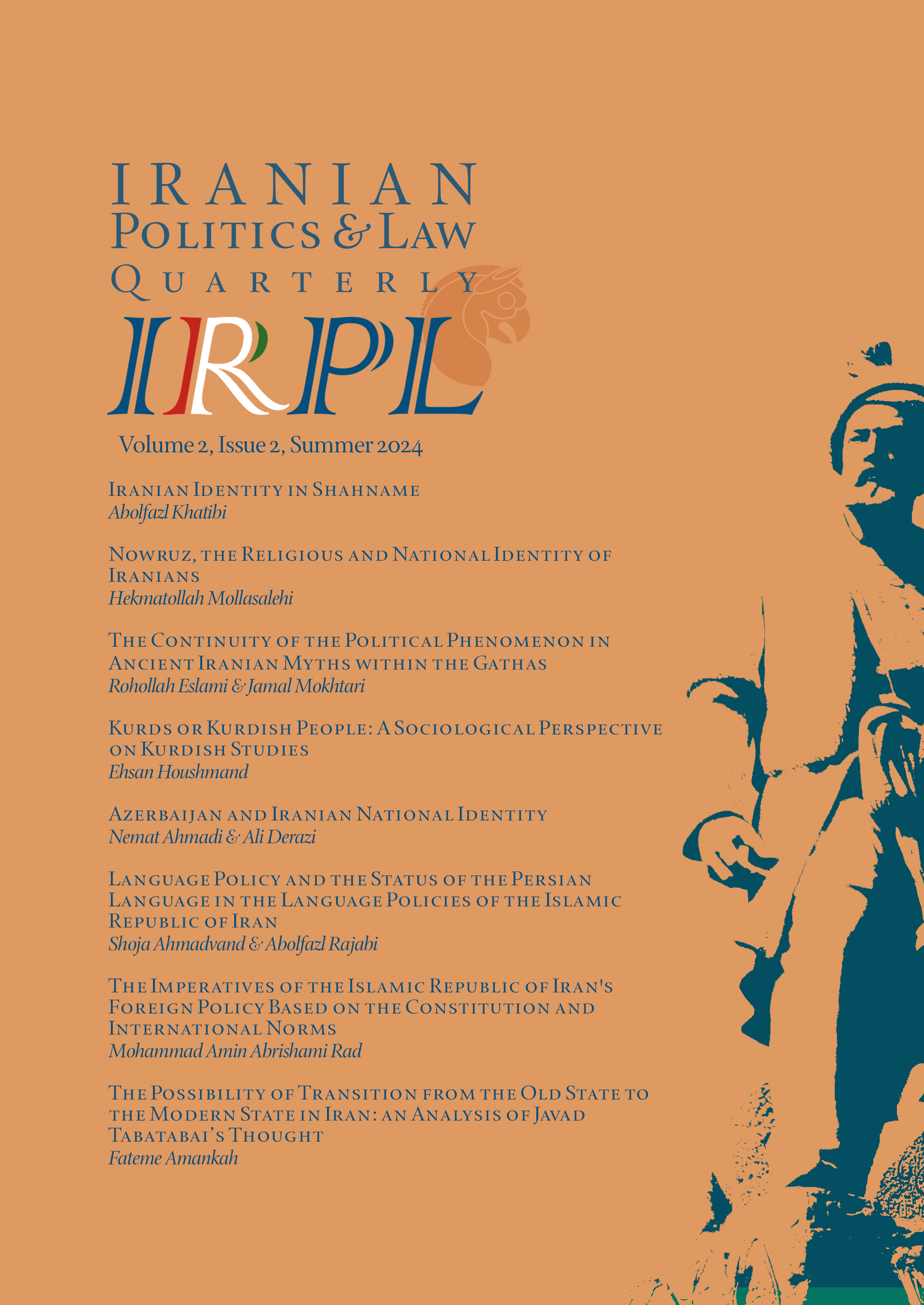
Iranian Politics and Law Quarterly

Iranian Politics and Law Quarterly

Iranian Politics and Law Quarterly is a peer-reviewed academic publication dedicated to advancing scholarly discourse on the intricate dynamics of Iranian history, politics, and law. As a cornerstone of intellectual inquiry, the journal invites rigorous explorations into the foundations of Iranian governance, from the evolution of its state and political institutions to the development of its legal and political thought, both historically and comparatively. Additionally, we welcome contributions that engage with topics such as political and historical sociology, national identity and culture, foreign relations, and public policy within the Iranian context.

IRPL extends an invitation to scholars and enthusiasts to engage with and contribute to the discourse on Iranian politics and law. Recognized by Iran's Ministry of Science, Research, and Technology in 2021, we uphold a commitment to academic excellence and the dissemination of scholarly insights. IRPL operates on an open-access basis, ensuring accessibility to all.


Publication Information

Publisher
Iranian Politics and Law Quarterly

Director-in-Charge
Editor-in-Chief
Associate Editor
Editorial Board

Frequency
Quarterly

Indexing and Abstracting

Keywords Cloud

  • Iran
  • Iranian Identity
  • nationalism
  • Iranian National Identity
  • Persian language
  • Islam
  • National Identity
  • Islamic Revolution
  • Middle East
  • nationality
  • Society
  • Wicked Issues
  • Wahhabism
  • The Persian Constitution
  • Country
  • philosophical and historical approach
  • rational society
  • COVID19
  • Political Geography
  • Iranian national epic
  • Non-belligerent States
  • Regional security
  • Kurdish identities
  • Allame Jafari Tabrizi
  • Imaginary Institution
  • Iranian nation
  • Azeri
  • Provincial and regional councils
  • Public Policy
  • Stakeholders
  • Parliament
  • Azerbaijan
  • tribe
  • Nigeria
  • possibility
  • Tourism
  • Islamic modern civilization
  • Resources curse
  • National language
  • Ibrahim Zakzaki
  • reason
  • Kurds
  • Republic of Azerbaijan
  • Conflict of interest
  • Armenia
  • Continuity of Iran
  • im- possibility
  • Policy Coherence
  • Corruption
  • Amesha Spentas
  • Persian Gulf
  • First Constitutional Assembly
  • Khshathra
  • Tradition
  • Collective Action Problem
  • Gathas
  • Ferdowsi
  • Abu Musa
  • international relations
  • Rivalry
  • Mahdism
  • Ayatollah Javadi Amoli
  • Settlement
  • historical sociology
  • Shiism
  • Britain
  • Shahanshahi
  • evolution
  • Iranian Sovereignty
  • Africa
  • Convergence
  • Ethnoreligious conflicts
  • migration
  • Language Policy
  • Cultural integration
  • Islamic mouvement in Nigeria
  • Prosperity
  • Iranian Constitution
  • Resilience
  • Transparency
  • cultural diplomacy
  • Political Economy
  • hard power
  • rational life
  • Soft power
  • Turbulence Environment
  • Iranian Culture
  • modernity
  • Smart power
  • State
  • Greater and Lesser Tunbs
  • Kurdish studies
  • archaism
  • Nowruz rituals
  • Foreign Policy
  • Bumusa
  • Responsibility to Protect
  • raison d\'être
  • Qashqai
  • Iranian religion
  • Network Governance
  • legislature
  • Shahname
  • Three Iranian Islands