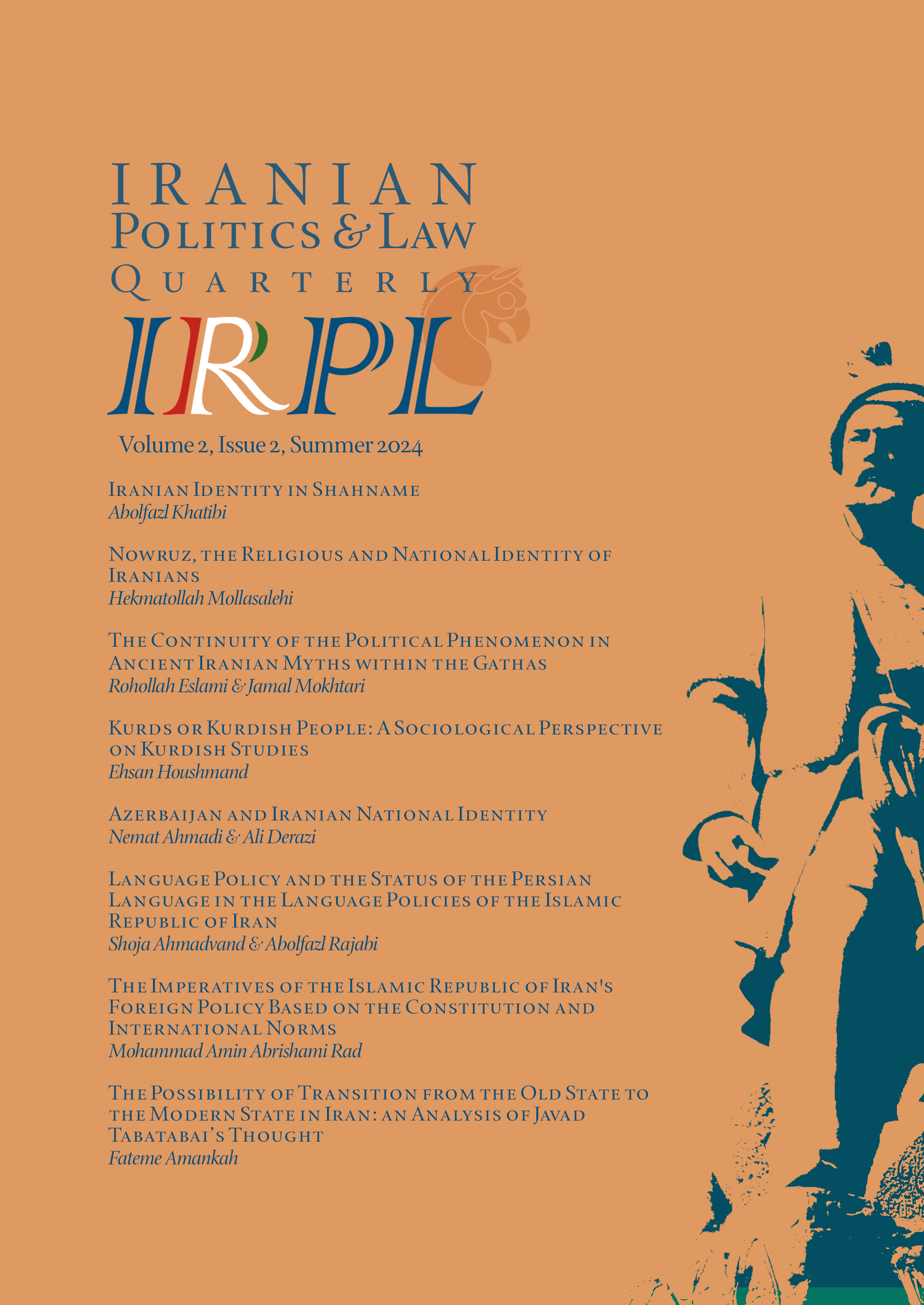
The transition from tradition to modernity represents a significant challenge in the humanities, particularly in the realm of political science where the shift towards the modern state is a focal point of inquiry. This process of transition engenders an interim period characterized by uncertainty, resulting in a critical and unstable state identity in Iran. The liminal state and the concomitant absence of a defined identity are central themes in the scholarly work of Javad Tabatabai. He posits that the modern era of Iranian history commenced at a juncture where traditional paradigm proved inadequate in addressing the exigencies of the new world order. He conceptualizes contemporary Iran as existing in a state of liminality, neither fully traditional nor modern, encapsulating the current Iranian crisis. This contemporary thinker elucidates the continuity of Iran amidst its decline through a complex system of concepts, with the notion of “Iranshahr” at its core. Notably, Tabatabai’s proposed solution neither advocates a return to tradition nor suggests a mere replication of European modernity. While his ultimate objective is to contribute to the establishment of a modern tradition of thought, with an emphasis on political philosophy, he recognizes that the transition from the old state to the...
amankah, F. (2024). The Possibility of Transition from the Old State to the Modern State in Iran: an Analysis of Javad Tabatabai’s Thought. Iranian Politics and Law Quarterly, 2(2), 101-115. https://doi.org/10.22034/irpl.2024.462371.1010
MLA
amankah, F. "The Possibility of Transition from the Old State to the Modern State in Iran: an Analysis of Javad Tabatabai’s Thought", Iranian Politics and Law Quarterly, 2, 2, 2024, 101-115. doi: 10.22034/irpl.2024.462371.1010
HARVARD
amankah F. (2024). 'The Possibility of Transition from the Old State to the Modern State in Iran: an Analysis of Javad Tabatabai’s Thought', Iranian Politics and Law Quarterly, 2(2), pp. 101-115. doi: 10.22034/irpl.2024.462371.1010
CHICAGO
F. amankah, "The Possibility of Transition from the Old State to the Modern State in Iran: an Analysis of Javad Tabatabai’s Thought," Iranian Politics and Law Quarterly, 2 2 (2024): 101-115, doi: 10.22034/irpl.2024.462371.1010
VANCOUVER
amankah F. The Possibility of Transition from the Old State to the Modern State in Iran: an Analysis of Javad Tabatabai’s Thought. IRPL. 2024;2(2):101-115. doi: 10.22034/irpl.2024.462371.1010